Why Build an XP Farm?
An XP farm turns excess production into permanent upgrade points instead of leaving it in storage. The best version protects your income first, then sends spare relics and unwanted outputs to a Knowledge Altar.
A Knowledge Altar costs 24 Stone and converts items into experience for Knowledge Levels. It can consume ordinary items, but relics are the strongest foundation for a dedicated farm because they provide extra experience.
| Farm goal | Best input | Why it helps |
|---|---|---|
| Early levels | Spare regular products | Clears overflow while adding experience |
| Steady mid-game XP | Lower-tier relics | Supports gradual leveling without stopping growth |
| Major level jumps | Saved high-tier relics | Makes temporary Relic Knowledge investment worthwhile |
| Factory cleanup | Unneeded outputs | Turns surplus into progress |
Do not rush into feeding valuable products to the altar if your factory still lacks money, basic materials, or fuel. An XP farm should use true surplus. If selling an item would fund another critical machine or production line, keep it for the shop instead.
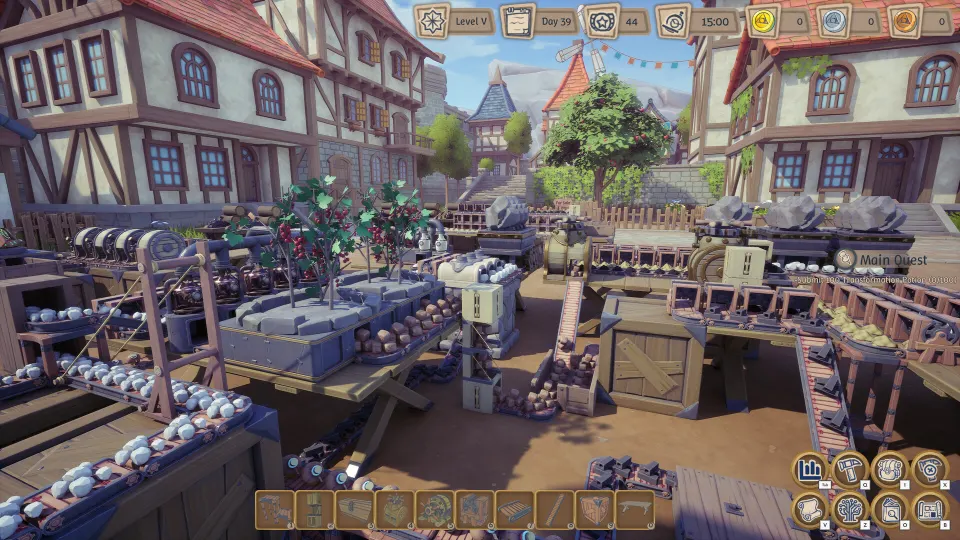
Set Up the Core Loop
The core loop is simple: produce relics, reserve enough output for sales, store the remainder, and feed it into the Knowledge Altar. Storage matters because it gives you control over when relics become experience.
Place containers between relic production and the altar. This prevents your factory from instantly consuming every relic and lets you prepare for a larger leveling session later.
- Build the Knowledge Altar near relic storage, not directly on a new production line.
- Split relic output between sales and a storage buffer.
- Use ordinary-item overflow for excess products that have no immediate purpose.
- Increase altar input only after shop income and essential supplies are stable.
- Save relic batches before resetting points into Relic Knowledge.
| Component | Main job | Common mistake |
|---|---|---|
| Knowledge Altar | Converts items into XP | Feeding valuable output too early |
| Storage container | Holds relics for later | Using too little buffer space |
| Splitter or filter | Protects sale inventory | Letting the altar drain shop stock |
| Shop line | Funds expansion | Treating relics as XP-only items |
| Overflow line | Handles spare items | Sending needed intermediates to XP |
The ideal split changes as your economy develops. When money is tight, sell more relics and use ordinary overflow for experience. Once sales are reliable, send a larger share of relic production toward leveling.
Avoid forcing a compact layout before you need one. Extra room makes it easier to separate sales, relic storage, and altar inputs. A clear setup is also easier to pause or rebuild when a higher relic tier becomes available.
Turn Relic Stockpiles Into Levels
Relics are an experience reserve. Jupiter, Saturn, Mars, Venus, Mercury, Luna, and Sol can all be stored until you have a reason to consume them, rather than being extracted the moment they arrive.
Relic Knowledge increases experience gained from relic consumption. The strongest farming approach is to accumulate a meaningful batch, reset points into Relic Knowledge, consume relics, and place newly earned points into that same upgrade as you level.
| Relic group | Recommended handling | Best use |
|---|---|---|
| Jupiter, Saturn, Mars | Consume steadily or save modest batches | Early and mid-game progress |
| Venus, Mercury | Build larger reserves | Dedicated XP sessions |
| Luna, Sol | Protect as high-value reserves | Large late-game level gains |
| Mixed storage | Sort by tier when practical | Easier planning and comparison |
This creates a snowball effect during a leveling session. The first relics grant levels, the new points improve Relic Knowledge, and later relics in the batch benefit from the stronger bonus.
Do not reset for a handful of relics. The reset is most useful when the expected experience gain is large enough to outweigh its cost and the time needed to rearrange your build.
A relic line is only good if it is sustainable. More relics per minute are not automatically better if the line consumes enough fuel, fertilizer, or machine capacity to weaken shop income and slow the rest of the factory.
Spend Points on the Current Bottleneck
Experience is valuable because it gives upgrade points, but those points should solve the restriction limiting your factory now. Faster belts help when items back up. Faster machines help when production cannot keep pace. Fuel and fertilizer upgrades become stronger as their costs rise.
| Upgrade | Main effect | Prioritize when |
|---|---|---|
| Logistics Efficiency | Raises belt speed | Transport lines are congested |
| Factory Efficiency | Improves device and heat performance | Machines or cauldrons are slow |
| Fuel Efficiency | Improves fuel heat value | Heat-heavy production is costly |
| Fertilizer Efficiency | Improves nutrient value | Plant production uses constant fertilizer |
| Alchemy Skill | Improves Extractor output | Extractors limit advanced chains |
| Customer Management | Improves quest rewards | Early quest returns help growth |
| Relic Knowledge | Improves relic XP | A large relic reserve is ready |
Customer Management can be useful early if quests are supporting your economy. Logistics Efficiency is often noticeable quickly because it improves many connected lines at once.
In the middle game, Logistics Efficiency and Factory Efficiency often complement each other. Faster belts do little when machines remain slow, while faster machines can simply create more blocked outputs when transport is limited.
Fuel Efficiency becomes increasingly useful around heat-demanding production such as Blast Potions and Paradox Crucibles. Alchemy Skill is valuable when Alembics or Extractors control advanced potion throughput.
Reset With a Purpose
Upgrade points can be reset repeatedly. The price rises with repeated resets, eventually reaching a maximum of 10 Gold, so use resets as planned events rather than a response to every small issue.
For an XP-focused reset, save relics first. Move points into Relic Knowledge, consume the batch, assign new points there while leveling, then reset back to the production build that keeps your factory running.
| Reset situation | Best response | Reason |
|---|---|---|
| New production stage | Rebuild around the new bottleneck | Old upgrades may no longer matter |
| Large relic reserve | Shift into Relic Knowledge | Improves the value of saved relics |
| Small relic batch | Keep normal upgrades | Reset cost may not pay off |
| Clogged belts | Add Logistics Efficiency | Restores flow across the factory |
| Expensive heat demand | Add Fuel Efficiency | Reduces fuel pressure |
Before resetting, note your current allocation if the factory is running smoothly. It is easy to remember that a build worked well but forget the exact balance between belts, factory speed, fuel, and fertilizer.
After a reset, watch your supply lines. Changing upgrades can alter how quickly devices consume fuel or fertilizer, and a shortage can interrupt several connected production chains.
FAQ
What is an alchemy factory xp farm?
An alchemy factory xp farm is a setup that collects surplus items, especially relics, and feeds them into a Knowledge Altar for experience. It raises Knowledge Levels and earns upgrade points without relying on unwanted storage buildup.
Should every relic go into the Knowledge Altar?
No. Reserve enough goods for sales, contracts, and factory expansion. Send relics to the altar after your essential economy is stable, or split output between sales and XP storage.
Which upgrade levels the fastest?
Relic Knowledge directly improves experience from consumed relics. It is most effective with a large saved batch, especially higher-tier relics. Otherwise, prioritize the upgrade that removes your current factory bottleneck.
Is resetting for relic XP worthwhile?
It is usually worthwhile for a large relic reserve. Reset into Relic Knowledge, consume the stockpile, then return to production upgrades. Avoid frequent resets for small batches because their price rises.
Can ordinary items generate experience?
Yes. Knowledge Altars accept ordinary items, making them useful for clearing excess production. Relics are generally better for dedicated XP farming, while regular items work well as overflow.