Why Main Quests Matter
Alchemy Factory main quests are the game’s real progression gates: completing them raises your Alchemy Level and opens new portions of the Research Tree. Contracts, shop sales, land purchases, and random quests can make your factory stronger, but they do not replace the current Association assessment.
When research appears blocked, check the Main Quest panel first. Its required submission tells you which production line deserves your materials, floor space, and upgrade points right now.
A good progression rhythm is simple:
- Read the current Main Quest before expanding a production line.
- Build only enough capacity to complete its target reliably.
- Submit the requirement and inspect the newly unlocked research.
- Fix the new bottleneck before committing to optional projects.
- Preserve useful inputs instead of consuming them in old, oversized lines.
This approach prevents a common problem: a factory that earns money and looks busy but remains stuck at the same Alchemy Level.
| Activity | Helps progression by | Raises Alchemy Level? |
|---|---|---|
| Main Quest assessment | Unlocking the next research tier | Yes |
| Random quests | Providing rewards and short-term income | No |
| Customer sales | Generating money and clearing surplus | No |
| Contracts | Supplying materials or income | No |
| Factory upgrades | Improving throughput and logistics | No |
| Land expansion | Creating room for future production | No |
Main quests are especially valuable early because their rewards can include currency and materials that would otherwise take time to buy or produce. Treat them as the factory’s current production contract, not as an optional checklist.
Early Main Quest Route: Levels 1 to 4
The opening quests teach the basic loop: turn raw resources into components, move them through machines, store the output, and submit the requested goods. Your first layouts should be compact and temporary. Better machines, recipes, and logistics arrive quickly, so avoid designing a permanent starter factory too early.
The first completion moves you from Level 1 to Level 2. Early research begins to introduce materials such as flax and limestone, while wood and stone remain important for construction.
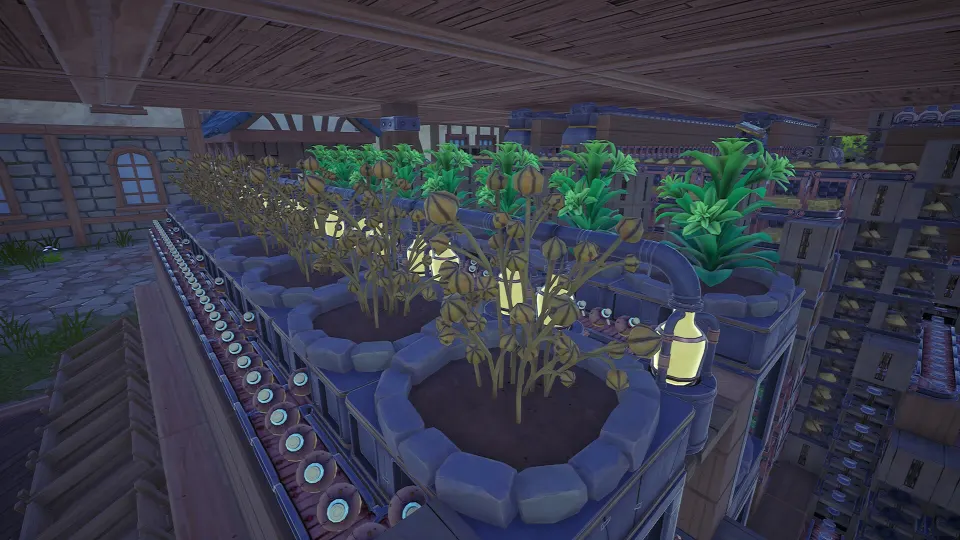
The Level 2 requirement is a batch of 50 Linen Rope. This is the first quest that asks you to sustain a multi-step agricultural chain rather than assemble a few simple components. Grow flax, process it into the required intermediate products, then reserve enough output to finish the rope submission.
Do not leave an oversized rope line running after the target is met. Flax soon becomes a contested input.
At Level 3, the Association requires 100 Healing Potions. This is a major shift because the potion line uses processed flax fiber and sage powder. If rope production still absorbs your flax, Healing Potion progress can feel unexpectedly slow even when every machine has power and inputs.
| Level transition | Main Quest focus | Likely production pressure | Practical response |
|---|---|---|---|
| Tutorial to Level 2 | Opening Association tasks | Wood, gears, storage, stone | Keep the first layout flexible |
| Level 2 to 3 | 50 Linen Rope | Flax processing | Build enough for the batch, then stop scaling |
| Level 3 to 4 | 100 Healing Potions | Flax fiber and sage powder | Redirect crops toward potions |
| After Level 4 | New research and automation | Layout and product routing | Reassess before rebuilding |
Level 4 is a useful checkpoint rather than an ending. New automation options, including the Automatic Cashier, make shop operations easier, but your next assessment still determines the best direction for the factory.
Early on, main quest submissions are usually more valuable than selling the same goods to customers. Selling excess stock is fine, but do not sell materials that you will immediately need for the next assessment.
Midgame and Late-Game Quest Planning
The middle of the game increases both recipe depth and factory scale. Main quests begin to demand longer chains involving liquids, processed minerals, fertilizers, steel, relics, and advanced potion production.
Vitality Potion progression expands the number of connected systems you must manage. Quicklime, liquid handling, and upstream processing become more significant. The temptation is to tear down everything and build a perfect factory, but it is usually better to unlock the next tier first and rebuild only the bottleneck that blocks the active requirement.
Level 5 includes a target of 100 Transformation Potions. At this stage, advanced fertilizer, filtering, steel, and larger layouts become increasingly relevant. However, reaching Level 5 does not mean the game has become an unrestricted sandbox. It is still best to let the current assessment determine what receives scarce materials.
Levels 5 through 7 are often about stabilizing the new economy. Farming must scale, steel supports better equipment, and relic production becomes more important. Build storage buffers between major stages so one slow machine does not starve an entire chain.
| Progression stage | Systems that become more important | Main planning concern |
|---|---|---|
| Level 4 to 5 | Liquids, quicklime, longer recipes | Avoid rebuilding before research unlocks |
| Level 5 | Advanced fertilizer, filtering, steel | Support Transformation Potion production |
| Levels 5 to 7 | Larger farms, equipment, Jupiter relics | Reserve room for expansion and buffers |
| Level 7 to 8 | Higher relics and expensive resources | Separate complex input chains |
| Levels 8 to 9 | World Tree, advanced metals, high relics | Follow the active requirement, not every branch |
| Final chain | Philosopher’s Stone and top-tier goods | Finish remaining assessments |
Late-game quests can require expensive inputs that are slow to replace. Avoid routing every output directly into the next machine. A chest or container buffer lets you inspect production, protect materials for a quest turn-in, and recover from a stalled upstream line.
Reaching Level 9 is not necessarily the same as completing the game. Continue checking the Main Quest chain until its remaining objectives, including final high-tier production, are fulfilled.
Factory Habits That Keep Quests Moving
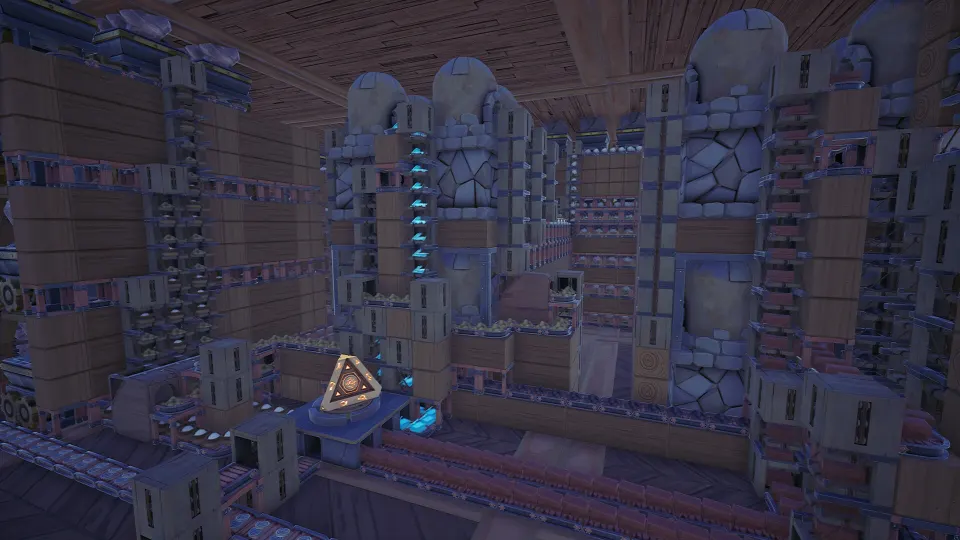
The best factory for main quest progress is not always the prettiest or most profitable one. It is the one that reliably converts the correct resources into the current target without starving future production.
Keep a dedicated personal storage area for building materials and quest items. This reduces accidental sales, keeps construction components available, and makes it easier to see whether you have reached a submission threshold.
Balance machine throughput where practical. For example, an early table saw can supply multiple grinders, but conveyor capacity and machine input rates still matter. A belt that receives more items than it can move becomes a hidden production limit.
Upgrade choices should support the bottleneck you actually have. Factory efficiency and conveyor speed are broadly useful early because they improve production flow. Fuel efficiency and fertilizer efficiency become more valuable when heating and farming costs become meaningful.
Use optional activities with purpose:
- Complete profitable random quests when they do not consume the Main Quest supply.
- Sell excess goods to create space or fund a needed purchase.
- Use contracts to cover gaps in hard-to-produce materials.
- Expand land when the current chain cannot fit cleanly.
- Save reusable blueprints for stable modules, such as farming blocks or basic processing lines.
Skill resets can also be useful later, especially before turning in a major quest or extracting relics. A player may temporarily invest in relic-related bonuses for withdrawal, then shift toward quest rewards for the submission. This is a situational optimization, not a requirement for ordinary progress.
For large potion or relic milestones, calculate the full ingredient requirement before changing skills or starting a final batch. Producing the ingredients in one focused run can be safer than repeatedly switching a partially completed line between recipes.
FAQ
What are Alchemy Factory main quests?
They are Association assessments that ask you to submit specific items. Completing them increases Alchemy Level and unlocks gated Research Tree tiers.
Why is my research tree locked even though I have enough money?
Some research nodes require a higher Alchemy Level. Complete the active Main Quest assessment to raise that level; currency alone cannot bypass the requirement.
Should I prioritize main quests over customer sales?
Usually, yes, especially early. Main quest rewards and level unlocks provide more direct progress than ordinary sales. Sell surplus, but keep materials needed for the current submission.
What should I do after completing a main quest?
Check the new research unlocks, identify the next required item, and adjust only the production lines that block it. Avoid expanding every system at once.
Do I need a permanent factory layout for early quests?
No. Early quests introduce new machines and recipes quickly. Compact, adaptable layouts are better until your production chains become stable.